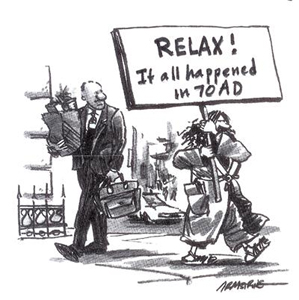
"Extreme Preterism" is a very controversial doctrine, called a "damnable heresy" by some, who warn that it is the fastest-growing eschatological perspective today, and is rapidly infecting churches, and Pastors should be on their guard against it.
I have come to believe that "Extreme Preterism" is the Biblical position, and I'm confident I can persuade you that it's true.
If you're willing to hear the case.
But if you're like most people, you've been trained to actively avoid hearing the case for "extreme preterism." You've been told by your Pastor or favorite writer that you should cover your ears and eyes when you see a full preterist coming toward you.
Most people don't like someone who's vilified as an "extremist." But the Bible requires Christians to be "extremists," which is why Christians are not liked by the world. Another word for "extreme" is "logically consistent." Jesus said we are to love God and our neighbor with 100% of our heart, 100% of our mind, 100% of our soul, and 100% of our strength, and most people consider that kind of thinking to be "extreme." Extremism is a virtue. Being lukewarm in the middle is not (Revelation 3:15-16).The only problem with "extremism" is when we are logically consistent with an unBiblical premise, and such logical consistency causes us to deny a Biblical commandment.
Every Christian Reconstructionist is a "preterist," and becoming logically consistent with that preterism might be called "extreme preterism," but that's only a problem if it must deny certain teachings of the Bible. More about "extremism."
"Preterism" comes from the Latin word for "past."
A "preterist" interpretation of a prophecy claims that the prophecy was fulfilled in the past.
Isaiah predicted (chapter 10) that Assyria would attack Israel. Every Bible scholar is a "preterist" on this chapter. It already happened. It was fulfilled between 740 and 720 B.C.
We'll call this "partial preterism." Every "futurist" is also a "partial preterist."
But there are passages under dispute. Some scholars say Matthew 24 was fulfilled in AD 70 when Jerusalem was destroyed by Roman armies ("preterism"). Other scholars say that the prophecy will be fulfilled in our future ("futurism").
A consistent ("extreme") preterist claims that all prophecies have been fulfilled. All of them. Already. In our past.
Even those prophecies about a "Second Coming" of Christ. Fulfilled in the past.
Many non-preterists will say that a consistent preterist is not even a Christian. Anyone who denies a future coming of Christ has denied the ecumenical creeds, which all affirm that Christ will come again (in our future).
But the only question that really matters is whether an "extreme preterist" denies any verses of the Bible.
The question is whether there is a single event prophesied to occur in our future. The consistent preterist says there is no such prophesied event. Every prophesied event has already taken place, and every state or condition that was prophesied to come about has already commenced. (Isaiah speaks of a coming "new heavens and new earth," in which houses will be built and vineyards planted. The consistent preterist does not claim that every house that will ever be built has already been built, and every vineyard that will ever be planted has already been planted; only that the building of houses in the "new heavens and new earth" commenced in the past.)
Reconstructionist writer David Chilton became a consistent preterist. He concluded that the prophecies in the New Testament were all about the events surrounding the destruction of Jerusalem in A.D. 70. He concluded that there were no prophecies in the Bible about a future (for us) Second Coming. However, he was not considered an "extreme preterist" at that time because he continued to believe that there would be another coming of Christ in our future, even though no writer in the Bible spoke of such an event. The reason Chilton continued to believe in that future Coming, even though not taught in the Bible, was because "Holy Mother the Church has taught that doctrine for two thousand years." His eschatology was a by-product of his ecclesiology. Chilton was a part of the high-church thinking of Reconstructionists in Tyler, Texas. "Rev. Chilton" wore a clerical collar. I do not know if he continued wearing a clerical collar after he began to identify as a "full preterist."
Thus, your assessment of consistent preterism is likely dependent on whether you identify as a "Rushdoony Reconstructionist," or a "Tyler Reconstructionist."
So in answer to the question "What is Preterism?" preterism is either a damnable heresy, or it is a way of looking at the Bible which radically differs from 99 out of 100 Christians.
I would like to suggest that if you like Christian Reconstructionism, you'll love "extreme preterism." "Extreme Preterism" is Christian Reconstructionism on steroids.
Gary Demar co-authored a book with Gary North in 1991 entitled, CHRISTIAN RECONSTRUCTION What It Is, What It Isn't. He wrote:
|
Christian Reconstruction, unlike Christian "movements" in general, has no central director, no overall, tightly controlled strategy. What unites Reconstructionists is their commitment to certain distinctive biblical doctrines that are fundamental to the Christian faith and have been supported by the church for centuries. In particular, Reconstructionists espouse the following distinctives:
|
One problem in defending "Christian Reconstruction" is that each of these 5 points is a separate and large body of thought, yet all five are inextricably linked, and defending one point entails raising the others.
The controversy over "Preterism" is related to Point Three above: a Reconstructionist preterist has a "victorious view of the future progress of the kingdom of God." Unlike the premillennialist, the preterist does not believe that Gospel prosperity depends on Christ returning to earth and ruling from a throne in Jerusalem. So the "extreme preterist" view of the current age is solidly Reconstructionist. The point of contention is whether or not there is prophesied in the Bible a future (for us) coming of Christ after a period of Christian Reconstruction. "Postmillennialism" is "optimillennialism," not "pessimillennialism." "Extreme Preterism," I would contend, is more optimistic than "lukewarm preterism," or "inconsistent preterism," or "partial preterism."
Rushdoony said that a concise definition of Christian Reconstruction "is well stated in the title of T. Robert Ingram’s excellent study, The World Under God’s Law." The Supreme Court of the United States at one time acknowledged that America was "a Christian nation." The Puritans sought to place all of human action under God's Law. Not just the church on Sunday, but all of life the rest of the week as well. Today the U.S. is an atheistic nation, as is most of Europe. But imagine being able to see the effect of India and China and the Islamic nations of the Middle East being "under" the authority of God's Law and Jesus Christ the Prince of Peace. Christian Reconstructionists believe all these non-Christian nations will become even more consistently Christian than America was in 1636 when Harvard University was founded to train Christian ministers of the Gospel.
It takes a big imagination to visualize "The World Under God's Law."
And Reconstructionists have said that all this happens before the Second Coming of Christ; that Christ does not return until after ("post") the "millennium" (that is, a "golden age" described in Revelation 20 as a "thousand years").
Question: How "under" does the world have to become before Jesus returns?
(Actually, under "postmillennialism," Jesus never literally "returns." His feet never touch the streets of Bethlehem or Jerusalem. At the "Second Coming," Christ simply ends all efforts at Christian Reconstruction on earth. "History" ends and "eternity" begins.) Perhaps the year before the Second Coming, Reconstructionists will have been trying to pass one additional Biblical law, or get one final unBiblical law repealed. Or convert one final remaining unbeliever. Or disciple that new believer.
Or further sanctify a long-time believer. But when the Second Coming occurs, will Christians in every nation on earth be sitting around with nothing left to reconstruct? Will every institution, every field of human action, and every individual, be completely "under" God's Law? Perfectly sanctified? Extremely reconstructed?
The Bible promises that perfectly faithful obedience will be blessed by God. Read Deuteronomy 28 and Leviticus 26. The day of zero remaining reconstruction will be the day of maximum blessings. All people will be willing to work productively to serve others and will find their labors blessed with abundance and prosperity. What are the economic implications of maximum blessing described in those two chapters? The economic implications are staggering. Prime rib is a nickel a pound. Investment in the economy's capital stock skyrockets, further increasing productivity and prosperity.
Why must Christian Reconstruction come to an end? Why must Jesus stop building civilization? Why must God's will cease being done on earth as it is in heaven (Matthew 6:10)? I don't know, but partial preterists say it must be thus.
Actually, the Bible never says that Reconstruction comes to an end. The Bible never says that Jesus stops being the Christ, the King, the Edifier (Builder) of the edifice of Godly civilization. Consider these verses:
Isaiah 9:6-7
6 For unto us a Child is born,
Unto us a Son is given;
And the government will be upon His shoulder.
And His name will be called
Wonderful Counselor, Mighty God,
Everlasting Father, Prince of Peace.
7 Of the increase of His government and peace
There will be no end,
Upon the throne of David and over His kingdom,
To order it and establish it with judgment and justice
From that time forward, even forever.
The zeal of the LORD of hosts will perform this.
The Messianic Kingdom is Everlasting.
Not just 10 centuries, as millennialists hold
Of the baby Jesus it was foretold:
Luke 1
32 He shall be great, and shall be called the Son of the Highest: and the Lord God shall give unto him the throne of his father David:
33 And he shall reign over the house of Jacob for ever; and of his kingdom there shall be no end.
This reign began 2,000 years ago. And it has only just begun.
This is not an easy concept. It raises a few thorny questions.
Here is an article critical of "extreme preterism": "Heretical Preterism"
This is the position of "the Church." The same institution which provoked a "Reformation" by screwing up a central doctrine of the Christian faith: Justification.
It does not bode well for an article that is highly critical of a position when that article does not fairly state the position it is attacking, nor anticipate the obvious rebuttals that will be offered by that position. None of the verses above are considered in that article. Nor are these:
Micah 4:5
Though all people walk each in the name of his god,
We will walk in the name of the LORD our God Forever and ever.Micah 4:7
I will make the lame a remnant,
And the outcast a strong nation;
So the LORD will reign over them in Mount Zion
From now on, even forever.Daniel 7:14
Then to Him was given dominion and glory and a kingdom,
That all peoples, nations, and languages should serve Him.
His dominion is an everlasting dominion,
Which shall not pass away,
And His kingdom the one
Which shall not be destroyed.Daniel 7:27
Then the kingdom and dominion,
And the greatness of the kingdoms under the whole heaven,
Shall be given to the people, the saints of the Most High.
His kingdom is an everlasting kingdom,
And all dominions shall serve and obey Him.’Revelation 11:15
Then the seventh angel sounded: And there were loud voices in heaven, saying, “The kingdoms of this world have become the kingdoms of our Lord and of His Christ, and He shall reign forever and ever!”Revelation 14:6
6 Then I saw another angel flying in the midst of heaven, having the everlasting gospel to preach to those who dwell on the earth—to every nation, tribe, tongue, and people—
The Book of Hebrews says Jesus is a priest forever after the order of Melchizedek (Hebrews 5:6; 6:20; 7:17,21). Many anti-preterists believe that no priestly intercession will be needed in the sinless New Heavens and New Earth.
The article above creates more problems than it solves.
In reply, it might be said that the "everlasting" kingdom will not begin until the Second Coming. Which is another way of saying that Jesus is not the reigning Messiah right now; not the Christ today. Which falls under the condemnation of 1 John 2:2. So while our position might be called "heretical," the opposing position might be called "antichrist."
|
There is nothing in the Bible that says that Jesus cannot make His people perfect. This perspective is pejoratively labeled "perfectionism." But again, there is no verse against this idea.
Throughout church history, it is frequently the case that "heretics" are persecuted because they want to raise moral standards in the church today, not because they want to lower them.
Was Chilton correct to conclude that there are no verses in the Bible that speak to us of a coming of Christ in our future? I believe he was. I realize that sounds crazy. Let me illustrate the preterist way of thinking.
Imagine a UFO lands in your front yard as you are mowing the lawn. The extra-terrestrial being who emerges from the craft informs you that he has come to earth to study the origins of the human race and our history. Rather than the customary "Take me to your leader," he says in effect, "Take me to your historian." Being the good Christian that you are, you give the E.T. a copy of the Bible, telling him (?) that this is the authoritative history of the human race. Being the good Protestant that you are, you also give him a copy of a standard reference work on hermeneutics so that E.T. can properly interpret the Bible.
You do not give him directions to the Vatican to have the Bible properly interpreted for him by "the Church."
When he applies the standard principles of hermeneutics to the prophecies of the Old Testament, he concludes that they have been fulfilled. For example:
Everyone agrees on the interpretation of these passages, that they were all fulfilled in the past (preterism). This is not an "extreme" position.
But when we come to similar prophetic rhetoric in passages in the New Testament regarding the "end of the world," the "coming of Christ, the "resurrection" and "The Last Judgment," E.T. ignores Hal Lindsay and the doomsdayers of today and comes to the conclusion that these events happened at the Second Coming of Christ, which happened within the lifetime of the generation that witnessed the first advent of Christ. Just as similar prophecies by Isaiah were fulfilled in the past.
The only way E.T. could come to any other conclusion is if he asked Popes and Bishops and other notable teachers of "the church" what the Bible is saying, and relied on their authority. If E.T. uses standard Protestant hermeneutics, E.T. becomes an "extreme preterist."
Let's start with these verses:
"The Judge will instruct the jurors to read every single one of those verses."
These verses show that the writers of the New Testament were focused, consumed, engrossed, dominated, engaged, and riveted with the promise that Jesus was going to return in their generation to take vengeance against those who murdered Him, destroy "the world" of the Old Covenant and bring in a "New Heavens and New Earth." Almost every page of the New Testament makes reference to an event that was assuredly going to take place before that generation died out (See Matthew 16:27-28). Here's a few verses on "this generation":
The difference between a "Full Preterist" and a "Partial Preterist" is that
If you are a "partial preterist," my question for you is this:
Which verse of Scripture
cannot rationally be interpreted
as having been intended by its author
to point the original audience to an event in their generation?
If there is a verse that cannot refer to the past, it must refer to the [our] future. This verse would disprove Full Preterism.
So I need to present dozens of verses to prove my position, but you only need to present ONE VERSE which will bring down my entire case.
There are more than 100 verses in the New Testament concerning "eschatology."
A "partial preterist" believes that many or most of these verses -- but not all -- have already been fulfilled in the past.
A full preterist believes that all of those verses were fulfilled in the past.
If you're a Partial Preterist, which verse is the Full Preterist misinterpreting?
I would say that the percentage of verses which have a past fulfillment is so predominant, and the energy in those verses (and throughout the New Testament) is so strong, that the "default" assumption should be "preterist." We should assume preterism unless there is clear and convincing evidence of futurism -- evidence from the text of Scripture itself.
That last phrase is critical: "evidence from the text of Scripture itself." We'll see why below.
Maybe your verse is not on that list. That's fine. Please tell me which verse that is, and why no rational person could claim that verse was intended by its author to describe something in the years AD30 - AD70, or why no rational person could deny that the verse was intended by its author to point to our future.
I asked this question on Doug Wilson's blog. Didn't get an answer.
We've used that word "eschatology" twice now. What does it mean? It comes from the Greek word ἔσχατος (eschatos), meaning "last," as in
|
But many that are first shall be last; and the last shall
be first.
|
The writers of the New Testament could not have been clearer: they were living in the "last days," the "last times," the "last hour." They were living in the "eschaton." There isn't a single verse in the New Testament which says that the eschaton would begin thousands of years in the future. We are no longer in "the end times." We are in The Beginning Times.
I think the verses in the "101 "Any Moment" Verses" page I referred to above prove that the "Second Coming" of Christ -- that is, His coming in vengeance against His enemies -- happened in the events of AD 70 and the destruction of the Old Jerusalem.
The objection to this Bible-based argument takes many forms, beginning with different events that are associated with the Second Coming, like Resurrection and Judgment. The argument is against the Bible:
How can you expect me to believe what the Bible says if no secular historian confirms it?
Are those 101 verses true and trustworthy, or are they not? If they say something would happen within 40 years, I believe it happened just like the Bible said it would, even if an Imperial propagandist for Rome does not mention the events in his reports.
The number of verses which say significant events would take place within 40 years (ask, "When?") is a much greater number than the number of verses which say something would happen (ask, "What?") that we just can't figure out exactly how it happened (ask, "How?") if it happened in the first century A.D.
Phillip G. Kayser is not a full preterist, but he admits that the Bible speaks of a resurrection to occur within that first century generation. Kayser gives us
a boatload of Scriptures which speak of an imminent judgment against Jerusalem, connected with an imminent resurrection that was about to happen, and an imminent age that was about to begin. Unfortunately the Greek word μέλλω in each of those verses is sometimes translated away. But that Greek word always refers to something that is about to happen. How do premils handle these verses? Well, they use them to prove that the Second Coming is about to happen and has been about to happen for the last 2000 years. Well, 2000 years after those Scriptures were written is not something that is about to happen. I won't take the time to go through the whole long list of Scriptures that have the Greek word μέλλω, but each of those references show some massive changes that would happen soon in AD 70. For now I want to focus on the verses that speak of a resurrection that was about to happen, since that is the one that so many people miss.
Acts 17:31 speaks about a resurrection. It says, "because He has appointed a day on which He will judge [And the Greek word is μέλλω - "is about to judge"] the world in righteousness by the Man whom He has ordained. He has given assurance of this to all by raising Him from the dead.” Why would Christ's resurrection be a guarantee of imminent judgment? Because Daniel connects judgment against Israel with resurrection. And we will look at the Daniel passage in a moment.
So Christ's resurrection was a down payment or an assurance (a firstfruits, so to speak) that guaranteed that there was about to be a judgment day with another resurrection. In terms of the barley harvest imagery that the Jews were familiar with, that would make sense because Christ's firstfruits resurrection was the assurance of the rest of the barley harvest [later, in AD70]. Look next at Acts 24:15. This is Paul speaking. He says,
I have hope in God, which they themselves also accept, that there will be a resurrection of the dead, both of the just and the unjust. (Acts 24:15)
The word "will be" is the Greek word μέλλω which refers to something very very near. It is more literally translated "that there is about to be a resurrection of the dead." Well, he said that about ten years before the AD 70 resurrection, so it was literally true. Look down at verse 25 where μέλλω occurs again.
Now as he reasoned about righteousness, self-control, and the judgment to come [literally, the judgment about to come], Felix was afraid and answered, “Go away for now; when I have a convenient time I will call for you.” (v. 25)
It was the very imminence of this judgment that made Felix afraid. Turn next to Romans 8:18. The whole context is the reversal of every facet of the curse, including the resurrection of our bodies, which in verse 23 Paul calls the "redemption of our bodies." But I want you to notice the use of the word μέλλω in verse 18.
For I consider that the sufferings of this present time are not worthy to be compared with the glory which shall be [literally, "which is about to be"] revealed in us. (v. 18)
In context Paul is saying that this glory is the redemption of our bodies. That glory is about to be revealed in us. Paul had already revealed that he would die prior to Christ's coming in AD 70, so he was about to be raised in AD 70.
Maybe one more verse. 2 Timothy 4:1.
I charge you therefore before God and the Lord Jesus Christ, who will judge [literally, who is about to judge"] the living and the dead at His appearing and His kingdom: (2 Tim. 4:1)
No New Testament writer directly prophesies a resurrection thousands of years in the future. Kayser infers a future resurrection based on his understanding of "the barley harvest," which is surely very indirect proof of that future event, if it is proof at all. Every New Testament writer speaks of a resurrection and a judgment that is "about to" happen, in their generation.
How exactly did this AD 70 resurrection take place? What was the exact nature of this resurrection? That's an interesting question, but it takes us far afield of our present inquiry, which is about the timing. WHEN was the event prophesied to occur? In that generation, or thousands of years in the future? The Bible repeatedly speaks of events that were "about to happen" to "this generation." The Bible never speaks of any events thousands of years in the future. That idea comes from "Holy Mother the Church."
But since we don't know exactly HOW the resurrection took place in the first century, then we also wouldn't know exactly HOW such a resurrection could take place after thousands of years of decomposition of the body and dissipation of the molecules of the flesh throughout the dust of the earth. If you believe God could resurrect a totally dispersed cadaver in the future, then it should be no great task to believe He did it when He said He would do it. We can affirm it even if we don't completely understand it.
So, in conclusion, believe in a future resurrection if you want to -- "it's a free country" -- but do not deny the verses in the New Testament which speak of a resurrection in the first century. Be like David Chilton: admit that the Bible is "preterist" because it speaks only of events in our past, and not in our future, and then, if you want to, believe what the Church creeds teach about the future.
But let's at least agree that the Bible teaches preterism.
All non-preterists believe that men must be resurrected before they can be judged on "the last day." But Jesus said The Great Judgment would occur within 40 years:
|
We begin with sinful Israel: |
Whosoever therefore shall be ashamed of Me and of My words in this adulterous and sinful generation; of him shall the Son of man be ashamed, when He shall come in His own glory, and in His Father's, and of the holy angels; and then He shall reward every man
according to his works. Verily I say unto you, There be some standing here, which shall not taste of death, till they see the Son of man coming in His kingdom with power. When the Son of man shall come in His glory, and all the holy angels with Him, then shall He sit upon the throne of His glory: |
We end with sinful Israel. |
| Matthew 16:27 For the Son of Man is about to come in the glory of His Father with His angels, and then He will reward each according to his works. 28 Assuredly, I say to you, there are some standing here who shall not taste death till they see the Son of Man coming in His kingdom.” | Mark 8:38-9:1 38 For whoever is ashamed of Me and My words in this adulterous and sinful generation, of him the Son of Man also will be ashamed when He comes in the glory of His Father with the holy angels.” 9:1 And He said to them, “Assuredly, I say to you that there are some standing here who will not taste death till they see the kingdom of God present with power.” | Luke 9:26 For whoever is ashamed of Me and My words, of him the Son of Man will be ashamed when He comes in His own glory, and in His Father’s, and of the holy angels. 27 But I tell you truly, there are some standing here who shall not taste death till they see the kingdom of God.” | Matthew 25:31 “When the Son of Man comes in His glory, and all the holy angels with Him, then He will sit on the throne of His glory. [Judgment and reward ensues.] | Matthew 19:28 So Jesus said to them, “Assuredly I say to you, that in the regeneration, when the Son of Man sits on the throne of His glory, you who have followed Me will also sit on twelve thrones, judging the twelve tribes of Israel. | Revelation 1:7 Behold, he comes with the clouds, and every eye shall see him, even they which have pierced him, and all the tribes of the land shall wail because of him. Yea. Amen. |
That means the "resurrection" must have occurred as well, in order for those once-dead people to stand before the Throne of God and be judged.
Or else the Bible is mistaken and untrustworthy.
My goal, it seems to me, is to figure out exactly WHAT happened and HOW it happened, but the WHEN is clearly stated: in the first century.
My job is not to say "I don't understand HOW it could have happened in the first century, therefore it did not happen, and MUST be something that will happen in the future."
Because the Bible doesn't hint at any of this happening thousands of years in the future. All the writers of the Bible plainly say the events associated with "the Second Coming" of the Messiah would all take place within the lifetime of the generation that witnessed the first coming of the Messiah.
Preterism is the result of a standard "historico-grammatical" analysis of the text of Scripture.
Futurism is the result of obedience to Popes and Bishops and the creeds of "the Church."
Consider another variety of "partial preterist." This third position still upholds a belief in a yet-future eschatological event, even though this position grants the claim of the "full preterist" that there are no verses of Scripture which teach that yet-future event.
As I mentioned above, in the last conversation I had with David Chilton on the phone, he said he had concluded (exegetically) that there are no verses in the New Testament which were intended by their author to predict events which were thousands of years in the future of the original audience. In his words, there are no verses which predict a future (for us) Second Coming.
But at that point David Chilton was not a "full preterist." Or at least he was not condemned as a "full preterist." That's because he went on to say that although no verses in the text of the Bible teach the doctrine of a future "Second Coming" [ future for us],
I believe the doctrine anyway because Holy Mother the Church has taught that doctrine for two thousand years.
I remember his words well. "Holy Mother the Church."
|
If you are a "partial preterist," or if you are not a "full preterist," |
Is it God's Truth or merely man's claim that someone who believes all the eschatological verses in the Bible were fulfilled by AD70 is not a genuine believer in Christ?
I've heard that claim.
I've heard it said that if someone embraces "full preterism," that person has "denied the orthodox faith" and is no longer a Christian.
Not a Christian.
Damned to hell for eternity.
Even if that person affirms the deity of Christ and His substitutionary atonement.
He's not a Christian.
Even if he's a six-day creationist and a five-point Calvinist.
Not a true Christian.
Even if that person affirms and defends the first 30 chapters of the Westminster Confession of Faith.
Dammed to hell.
Even if his behavior is characterized by moral purity and the spirit of Christ.
He denies one of the teachings of "the Church," and has therefore denied the "orthodox faith," and is therefore not a genuine believer.
He's not a real Christian because he's a "full preterist."
I'm not making this up.
I strenuously disagree with the claim.
Matthew 24:30 says,
"And then shall appear the sign of the Son of man in heaven; and then shall all the tribes of the land lament, and they shall see the Son of man coming on the clouds of heaven with power and great glory."
A "preterist" interpretation of this verse says it predicts events surrounding the destruction of Jerusalem in AD 70.
A "futurist" interpretation says this verse concerns events to take place thousands of years after Matthew recorded these words.
Leading Christian Reconstructionists take a "preterist" interpretation of Matthew 24. In fact, this way of viewing the verse is now considered "Eschatology 101" in Reconstructionist circles. Failure to interpret this verse in a preterist manner is a gateway drug to becoming a dispensational premillennialist.
I exaggerate slightly, but I'm being serious.
A few Reconstructionists, like Ken Gentry, have said that the second part of Matthew 24 is about a future second coming, but the first part (including verse 30) is talking about the fall of Jerusalem, and hence is to be understood preteristically. Everyone in the Reconstructionist camp agrees that verse 30 is a preterist verse.
But . . .
The Westminster Confession of Faith takes a "futurist" interpretation of this verse.
This is an exegetical error, according to nearly every Christian Reconstructionist.
In fact, all of the credal statements about the "Second Coming" (in our future) are based on this exegetical error.
The formulations of eschatology in the creeds are hermeneutically premillennial.
Premillennialism is a fundamental error.
It is based on statism. defeatism, and escapism.
The premillennial (futurist) hermeneutic is profoundly significant and influential.
It poisons one's entire Biblical Worldview.
Watch here for a link defending those claims.
Nobody in his right mind would say that Gary DeMar or Gary North are not Christians because they take a preterist interpretation of Matthew 24:30, even though they disagree with "the creeds" by doing so.
But there are many futurists who say that "Full Preterists" have denied the Christian faith and are not real Christians.
This is because "the faith" is defined for futurists by ecclesiastical promulgations, and not the Bible alone ("sola Scriptura").
They believe that the Holy Spirit has guided "the institutional church," and even if the Bible doesn't teach a future (for us) Second Coming, "Holy Mother the Church" does.
Let's just say for now there are 13 verses related to "the Second Coming."
"Full Preterists" believe all these prophecies came to pass in the years leading up to AD70 (because the writers of the Bible said they would, not because we have any "secular" evidence from The New Rome Times that confirms the fulfillment of these prophecies).
"Partial Preterists" believe at least one of these 13 verses is referring to an event that is still in our future.
But here's the interesting thing: partial preterists disagree among themselves as to which verse is which: "Is this verse AD70 or yet-future?"
Let's consider a dozen or so great Christian commentators, whom all would regard as genuine Christians.
Let's map out their interpretations of the various passages that are up for grabs in this debate.
| Text #1 | Text #2 | Text #3 | Text #4 | Text #5 | Text #6 | Text #7 | Text #8 | Text #9 | Text #10 | Text #11 | Text #12 | Text #13 | |
| John Calvin | Preterist | Futurist | Both | Pret | Pret | Fut | Both | Pret | Pret | Both | Fut | Pret | Pret |
| Gary DeMar | Pret | Preterist | Both | Fut | Pret | Both | Both | Pret | Both | Both | Pret | Both | Pret |
| R.J. Rushdoony | Fut | Pret | Preterist | Fut | Pret | Both | Both | Pret | Fut | Both | Pret | Both | Both |
| Gary North | both | Both | Fut | Preterist | Pret | Both | Pret | Both | Pret | Both | Both | Pret | Fut |
| David Chilton | Pret | Pret | Both | Pret | Preterist | Pret | Pret | Pret | Both | Pret | Pret | Pret | Pret |
| John Gill | Fut | Both | Both | Pret | Pret | Preterist | Both | Fut | Pret | Both | Pret | Pret | Fut |
| Matthew Henry | Pret | Fut | Both | Both | Fut | Fut | Preterist | Pret | Pret | Both | Fut | Fut | Both |
| Matthew Poole | Fut | Pret | Both | Fut | Both | Fut | Fut | Preterist | Pret | Both | Pret | Pret | Pret |
| Charles Spurgeon | Fut | Pret | Pret | Pret | Pret | Fut | Fut | Pret | Preterist | Fut | Pret | Pret | Pret |
| John Lightfoot | Pret | Both | Both | Fut | Pret | Both | Pret | Fut | Pret | Preterist | Fut | Fut | Pret |
| J.C. Ryle | Fut | Pret | Fut | Pret | Fut | Pret | Fut | Both | Fut | Both | Preterist | Fut | Fut |
| Craig S. Keener | Pret | Fut | Both | Fut | Pret | Fut | Pret | Pret | Both | Both | Fut | Preterist | Both |
| D. A. Carson | Fut | Both | Both | Both | Fut | Both | Pret | Both | Pret | Fut | Both | Pret | Preterist |
Though these commentators may differ (contradict) on their interpretations of the relevant texts, we would still grant that they are "rational," even though contradiction violates the laws of rational thought.
In addition to being "rational," we would agree that they are "faithful." Nobody would say that John Calvin was not a real Christian because he took a "preterist" interpretation of some of those passages. Nobody would say that R.J. Rushdoony was not a Christian because he took a "preterist" interpretation of some of those verses.
(A scholar may take a preterist position on all the verses, but may also take the position that at least one prophecy will have a "double fulfillment." That is, the original author intended to convey an imminent first-century event, but the prophecy will nevertheless have a second fulfillment thousands of years in his future, some time in our future, which the original author may not have even contemplated when he wrote the words to a generation he believed would see the fulfillment of his prophecy. Such a past-and-present interpretation is listed in the chart above as "both." As long as you believe at least one verse teaches a future (for us) second coming, you have the Seal of Approval from the anti-full-preterist crowd, even if you believe that all of the verses were originally preterist [prophesying events in the immediate future {"this generation"}] in the mind of the New Testament author.)
(Ultimately, such a person is relying on church authority rather than being strictly limited to the text, and using standard hermeneutics to interpret the text. If you say that Paul (for example) intended his original audience to interpret his words as referring to an event in their generation, but that his words will have a "double fulfillment" -- even if there is no textual evidence in the Bible itself that Paul intended his original audience to make that inference, and no other Scripture speaks of Paul's words with reference to events thousands of years after Paul wrote his words, you are relying on church authority to impose that meaning on Paul's words.)
But when it comes to exegeting the Bible, if you just happen to agree with Godly Christian scholars on just the right combination of verses (in the chart above, the interpretations indicated by bold brown typeface), there are some who will boldly say that you are not a Christian at all and are going to hell.
If you agree with Calvin's interpretation of verse #1, DeMar on verse #2, Rushdoony on verse #3, etc., you are a "Full Preterist" and you are not a real Christian.
Because you disagree with the teaching of "the church."
I think this is insane.
The phrase "Holy Mother the Church" refers to interpreters of Scripture which I would place at the very bottom of an expanded version of the chart above. This would include the names of Popes and Bishops you've probably never heard of. Many of them were "premillennial," which I would regard as a Jewish heresy. But they are called "the Church Fathers."
The "church fathers" were infected with Jewish premillennialism and Greco-Roman statism. Premillennialists -- and most amillennialists and post-millennialists are infected with the basic error of premillennialism -- deny that building the City of God, the New Jerusalem, is the responsibility of the Body of Christ in this age. It's like premils believe that Christ will hand the fulfillment of the Great Commission to the saints on a silver platter in the future.
(I would also note that many of those who do accept our responsibility to build the City of God in this current age deny that this work of building is accomplished solely by living and preaching the Gospel, not by the sword. To deny the use of the sword is, for them, the heresies of "pacifism" or "anarchism." I have said elsewhere that "anarcho-preterism" is the Gospel. The "good news" is that the entire planet will increasingly "obey the Gospel" and be blessed [(Galatians 3:8].)
Cornelius Van Til dissected "the Church Fathers," and found them deeply compromised philosophically and Biblically. Van Til's festschrift is entitled Jerusalem & Athens. The "Church Fathers" were generally Greeks, from "Athens," not Hebrews from "Jerusalem." This is important. Preterists and Futurists understand Matthew 24 differently based on their familiarity with the symbolic rhetoric of the Hebrew prophets. The "Church Fathers" generally did not think like Hebrews, but like Greeks. This affected their eschatology.
These men, despite great faith and accomplishments in some areas, should be called "the Church Babies" because they lived in the infancy of Christendom. That's the conclusion of James B. Jordan, who writes:
The true Fathers of the Church are Noah, Abraham, Joseph, Moses, Jeremiah, Jesus, Paul, Peter, and John, and the other Fathers in the Bible. These men, under the guidance of the Holy Spirit, created the apostolic deposit from which the Church always grows.
The men who came after them, in the first and second and third centuries, are not Church Fathers but Church Babies. This is how we should regard Ignatius, Irenaeus, Basil, the Gregories, and yes, even Augustine. [I]n terms of the corporate biography of the Church, they lived in the infant stage and their great accomplishments were only the beginning of that corporate biography. We appreciate what the Holy Spirit did with them, and the theological accomplishments they made, but to say that they understood everything and laid everything out definitively would be grotesque, ludicrous, and idiotic.
We actually have a better understanding of the Christian faith today than "the Church Fathers" did. Jordan continues:
We may think that because these men lived right after the apostles, they must have known a lot. Remarkably, this is not the case. Anyone who reads the Bible, climaxing in the New Testament, and then turns to the "apostolic fathers" of the second century, is amazed at how little these men seem to have known. The Epistle of Barnabas, for instance, comments on the laws in Leviticus, but completely misinterprets them, following not Paul but the Jewish Letter of Aristeas. It is clear that there is some significant break in continuity between the apostles and these men. What accounts for this? I can only suggest that the harvest of the first-fruit saints in the years before AD 70, which seems to be spoken of in Revelation 14, created this historical discontinuity.
"But didn't some of the earliest church fathers study at the feet of the Apostles?"
Maybe. But at what point in time? And what did they learn from the Apostles as the Apostles spoke outside of Scripture (which, unlike everything else the Apostles said, was "breathed out" by God [2 Timothy 3:16])? Even the Apostles, like Peter, were fallible, and even at times, in grave error:
But Jesus turned and said to Peter, “Get behind Me, Satan! You are an offense to Me, for you are not mindful of the things of God, but the things of men.”
Matthew 16:23
Yikes! How would you like Jesus Himself to say something like that about you?
Even after Christ's resurrection, the Apostle Paul said of Peter:
11 Now when Peter had come to Antioch, I withstood him to his face, because he was to be blamed;
13 And the rest of the Jews also played the hypocrite with him, so that even Barnabas was carried away with their hypocrisy.
14 they were not straightforward about the truth of the gospel
Galatians 2
Wow, that's a heavy charge against "the first Pope." Not an auspicious beginning for "church authority."
The "church fathers" are, at many points, an offense to King Jesus.
And, of course, Luther pointed out that "Holy Mother the Church" failed in her responsibility to safeguard one of the most precious and important doctrines of the entire Christian faith: Justification. (But we're to rest assured in their earliest conclusions regarding eschatology?)
Opponents of Full Preterism put their loyalty and allegiance to the "church" fathers ahead of the Bible fathers, whose canonical writings were breathed out by God. I would say that condemning a preterist who believes in the deity and substitutionary atonement of Christ, but denies that the New Testament predicts any eschatological events thousands of years in the future, is the height of ecclesiastical authoritarian arrogance.
And it is "authoritarian," because it seeks to subsume the authority of the Scriptures under the authority of "Holy Mother the Church." Such authoritarians likely have created an institution of their own ("the local church") which they seek to buttress. They are saying a person is not a genuine Christian because he puts the Bible ahead of Popes and Bishops and "the local church."
Excommunicating full preterists is the eschatological authoritarianism of the Westboro Baptist Church.
Is it the authoritarianism of your church?
I believe that what I've written above is a "prima facie case" for preterism. If it isn't refuted from Scripture, then the institutional church should be pronounced "guilty" of adding doctrines to the Bible.
The first reason people reject preterism is that many people want to be resurrected after they die so that they can have a "second chance." A life "do-over." And a life very much like the one they have now, but with no worries, no responsibilities, no cares, no burdens, no tears. This longing is certainly understandable, but it puts psychology ahead of theology. It puts the Bible in second place behind our own wishes.
In reply, I will simply say "It's a free country. You can believe anything you want."
But don't you want to tie your beliefs to the Bible in some way?
The question is sometimes posed,
"What if I'm on an ocean cruise and I fall overboard and I'm partially eaten by a shark, and then thousands of other fish eat the scraps that the shark didn't eat. Then these fish are eaten, or die and decompose on the ocean floor, and maybe in a thousand years all of the molecules of my body wash up on shore and are mixed with the sands of the beach. Can God still resurrect my body?"
...or...
"What about a person who died thousands of years ago, and worms have eaten his flesh, and the apple tree has nourished its leaves with his molecules, and other people have eaten apples with him inside? Can God still resurrect this saint's body?"
And of course the Bible AnswerMan assures the listener that God can still re-create the human body, just as He created Adam out of the dust of the earth.
If God can do that in the future, He could have done it in the past.
If you want to believe this because "Holy Mother the Church" teaches it, fine. But don't tell people that the Bible says there is going to be a mass resurrection thousands of years after the closing of the canon. Because it doesn't say that.
Jesus said that He would return in power and glory and judge the men of that generation, before the men of that generation died out.
New Testament writers repeatedly affirmed a "second coming" in that generation, and even that there was "about to be" a resurrection.
If you preach in the pulpit or post on Facebook that there is going to be another coming of Christ, another resurrection, and another judgment thousands of years in the future, and there isn't a single verse that says "another," will you eventually stand before God accused of being a false prophet (Deuteronomy 18:20; 13:5; Jeremiah 14:14-15;
Zechariah 13:2–5)?
You may have been taught all your life that those "anothers" will happen, and you may want those things to happen, but there isn't a single verse in the Bible that says they will happen. There are only man's ecclesiastical pronouncements to that effect.
But wanting, and having those desires confirmed by official pronouncements, makes it very difficult to be persuaded that they won't happen -- even if there is nothing in the Bible to support those desires.
So the first reason people find preterism unpersuasive is their entrenched beliefs about things they were told would happen in the future.
The second reason people find preterism unpersuasive has to do with the present.
We long for something in the future because we are ungrateful for what we have in the present.
But in a perverse sense, we are grateful for what we have -- because we refuse to sacrifice it so that future generations can have more.
We cling to what we have, and we want more of it, and resort to fraud and theft and war to obtain more.
Here's an example of that, which also hints at how we should use the Scripture.
Premillennialists are disappointed to hear that the second coming already occurred, because they have inflated imaginations of what that event would be like. Hal Lindsey and Tim LaHaye have written mega-bestselling books describing in the style of grand, Hollywood action flicks, the "Great Tribulation" and the "Rapture" and the "Millennium." When preterists point out that the verses they rely on were fulflilled, because those verses employ the same prophetic style as verses in the Old Testament -- what have already been fulfilled -- premillennialists are greatly disappointed. But partial preterists have come to terms with this reality, and admit that the "falling stars" rhetoric employed by Old Testament prophets and those prophets speaking in "the last days" of the Old Covenant were not foretelling literal astronomical marvels.
In the same way, when the prophets spoke of the glorious conditions that would result after the "stars fell" and the old creation was de-created, we tend to take those prophecies too literally. We imagine a self-centered, self-gratifying paradise, which is not what the prophets had in mind.
However . . .
(and I'm forced to keep saying "however" and "on the other hand," because we have a tendency to veer off the path to one side, and then to over-correct and veer off the other side, first to the left, and then to the right)
even though we over-embellish prophetic descriptions of the “Vine & Fig Tree” world and the New Heavens and New Earth, the prophets who uttered those prophecies would fall on their knees in gratitude and praise for what the predicted Messiah has already accomplished in his reign on earth.
We want another second coming of Christ because we're not satisfied with what Christ accomplished (or set in motion) during the first century at His first coming and at His first (and only) second coming.
A complete mental, spiritual, and emotional re-arrangement is required.
This will take some time.
We now live in The New Jerusalem.
Most people won't believe that.
Those who see the Biblical proof for that claim will at first be disappointed. They will have to shed a number of humanistic preconceptions.
For further study:
No, Don't "relax." Build.
Why should you study a doctrine which is so reviled and out of step?
I need to figure out a way to entice you to listen.
So here's what I have to offer.
I believe this: If you wrestle with the arguments for consistent preterism, you will experience
the most profound, beneficial,
massive, and lasting
personal transformation
of your entire life.
By "wrestle" I mean "take the Bible seriously."
Start with these three verses:
- Acts 17:11
- "Now the Bereans were more noble-minded than the Thessalonians, for they received the message with great eagerness and examined the Scriptures every day to see if these teachings were true."
You must be willing to study your Bible every day -- as students in every university in America were required to do in 1718 -- and challenge all earthly authorities -- in government and in seminaries -- with the Word of God.
- Proverbs 18:17
- "The first to state his case seems right until another comes forward and examines him."
Expect some of your cherished beliefs to be cross-examined.
You've already heard the "prima facie case" for futurism. Now listen to the defense's case for Preterism (past-ism).
- Proverbs 27:17
- "As iron sharpens iron, so one man sharpens another."
I'm willing to help sharpen you; I hope you're willing to help sharpen me.
Second, if you're serious about studying this issue, or if you aspire to be some kind of "influencer," I'd like to engage in a little "wager." I'm willing to put up $1,000.00.
I'll wager that if you thoughtfully and prayerfully consider the case for preterism, you will find your entire understanding of the Christian faith will be radically transformed.
|
I'm serious about the money.
I'll send $1,000.00 to your attorney to be placed in escrow. You read my verses and answer a 5th-grade level comprehension question about each verse. Wrestle with these verses and the contrary claims you have heard in your church and from all the televangelists. If at the end of my presentation you are not convinced that Preterism is a legitimate interpretation of the Bible, your attorney will give you my $1,000.00.
I might expect you to do the same, placing $1,000.00 in escrow which I will be paid if I provide you with the kind of transformation I predict you will experience. But you don't have to do anything. If you want to take me up on this wager, you don't even have to pay me if (when) you lose. Send an email to preterist-escrow at KevinCraig.us and let's make a wager. It will require you to study in depth all five points of Christian Reconstructionism.
Two Latin words, "first" and "face." We might say "first appearance." A "prima facie case" looks like an airtight case. "Open and shut." Enough to convict.
If the Prosecution does not present a "prima facie case" in a court of law, the Defense can move to dismiss the case without even presenting an argument in defense.
But if the Prosecution presents a "prima facie case," then the Defendant will be convicted unless the Defense overcomes the "prima facie case" presented by the Prosecution.